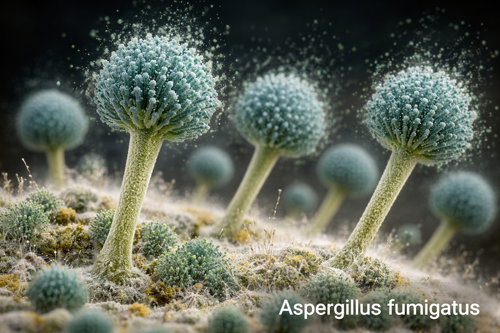
Understanding Aspergillus fumigatus
- Classification: A. fumigatus is a filamentous fungus belonging to the Aspergillus genus, which includes hundreds of mold species.
- Environment: It is common in soil, compost piles, and decaying plant matter, thriving in damp, warm conditions. Indoors, it can colonize HVAC systems, water-damaged walls, and even house dust.
- Health relevance: Its spores are small and easily inhaled, making them a direct threat to the respiratory system.
Health Risks
- Allergic reactions – For some, exposure leads to allergic rhinitis, sinusitis, or asthma exacerbations.
- Allergic bronchopulmonary aspergillosis (ABPA) – A hypersensitivity reaction seen in asthmatic or cystic fibrosis patients.
- Invasive aspergillosis (IA) – The most serious condition, occurring in immunocompromised individuals (e.g., chemotherapy patients, organ transplant recipients). Mortality rates can exceed 50% if untreated.
Chronic pulmonary aspergillosis – A long-term infection leading to lung damage and cavities.
Why It’s the “Most Dangerous” Mold
Tiny spores (conidia) can penetrate deep into alveoli.
- Thermotolerance: Can survive and grow at human body temperature (~37°C).
- Opportunistic behavior: Targets weakened immune systems.
- Drug resistance: Emerging azole resistance is a major clinical problem.
Environmental Mycologist’s Perspective
As a researcher, what fascinates me most is how A. fumigatus bridges the gap between an environmental saprophyte and a human pathogen. It doesn’t “want” to infect us—it thrives on decaying matter. But our built environments (damp walls, HVAC ducts, compost bins) give it opportunities. Climate change and agricultural fungicide use may be contributing to its rising resistance to medical antifungals—a concerning intersection of environment and medicine.
Practical Takeaways
- Hospitals must rigorously filter air to reduce Aspergillus exposure.
- Immunocompromised individuals should avoid gardening or compost piles.
- Indoor dampness must be controlled to prevent colonization.
- Research into new antifungal drugs is urgent.